
Strength, muscle size and power: what are you training?
Lifting a heavier kettlebell, building bigger leg muscles and rising quickly from a squat may look like closely related goals. They describe different things. Muscle size describes the amount of muscle tissue. Strength is the force you can produce in a particular task. Power adds how quickly you do mechanical work. A training programme can address several of these qualities without developing them to the same degree. 12
For people interested in longevity, this distinction offers something more tangible than chasing an impressive training weight. As we grow older, the movements in everyday life also matter: lifting an object, standing up or climbing stairs. Muscle size alone only partly describes these tasks. That is why the 2026 ACSM recommendations consider power and physical function alongside muscle size and strength. 1
Three connected goals
Muscle size: how much muscle is there?
An increase in muscle size is called hypertrophy. In training, this means a longer-term change in muscle size, rather than the weight you can lift right now. The ACSM review treats muscle size and strength as separate outcomes. 1
If building muscle is your main focus, training volume deserves attention. How many challenging sets does a muscle group receive across the week? How can you distribute them while keeping your movements controlled? A set is a group of repetitions completed before taking a break. Adding repetitions on a single day therefore tells only part of the story.
Strength: what resistance can you overcome?
Strength shows up in a specific task. Lifting more weight in the same exercise with comparable technique is a different kind of progress from having larger muscles. In resistance training, a one-repetition maximum, or 1RM, is the greatest load lifted once in a particular exercise. It is an exercise-specific measure. 1
Make your comparisons meaningful: the same exercise, the same range of motion and a recorded load. Moving a heavier weight through a shorter distance answers a different question from your previous movement. You do not need a maximal single attempt to get started. Recording the load and controlled repetitions in your usual sets is a practical first step.
Power: how quickly do you do work?
Mechanical power is work divided by time. If the same load is raised through the same height in less time, average mechanical power delivered to that load is higher. This is a simplified view of the lifting movement, not a calculation of calorie expenditure. 2
Power training therefore involves the intention to perform the lifting phase of a suitable movement quickly. The lowering phase remains controlled. Moving quickly does not mean rushing through the entire set. A familiar technique and an appropriate load are part of the task. 1
Load, volume and speed: what changes in training?
These goals are not separate compartments. General resistance training can produce changes in several areas. But choosing a particular emphasis does not always mean adjusting the same variable. The 2026 ACSM review highlights these relationships in healthy adults: 1
- Strength puts the focus on load. Higher relative loads were advantageous for developing measured maximal strength. Relative means in relation to your own capacity in that exercise, rather than a weight that suits everyone.
- Muscle growth brings volume into focus. The number of sets across the week can make a difference. This is not a reason simply to make every session longer. The aim is to combine a suitable amount of training with sufficient effort and repeatable technique.
- Power training deliberately practises a fast lifting phase. The review also identifies moderate relative loads for this goal. The heaviest possible weight is not automatically the right choice when movement speed is part of the aim.
Rep count, load and effort belong together rather than in rigid training zones. Rep ranges for muscle growth: what fits your training? explores how to apply that distinction when muscle growth is your goal.
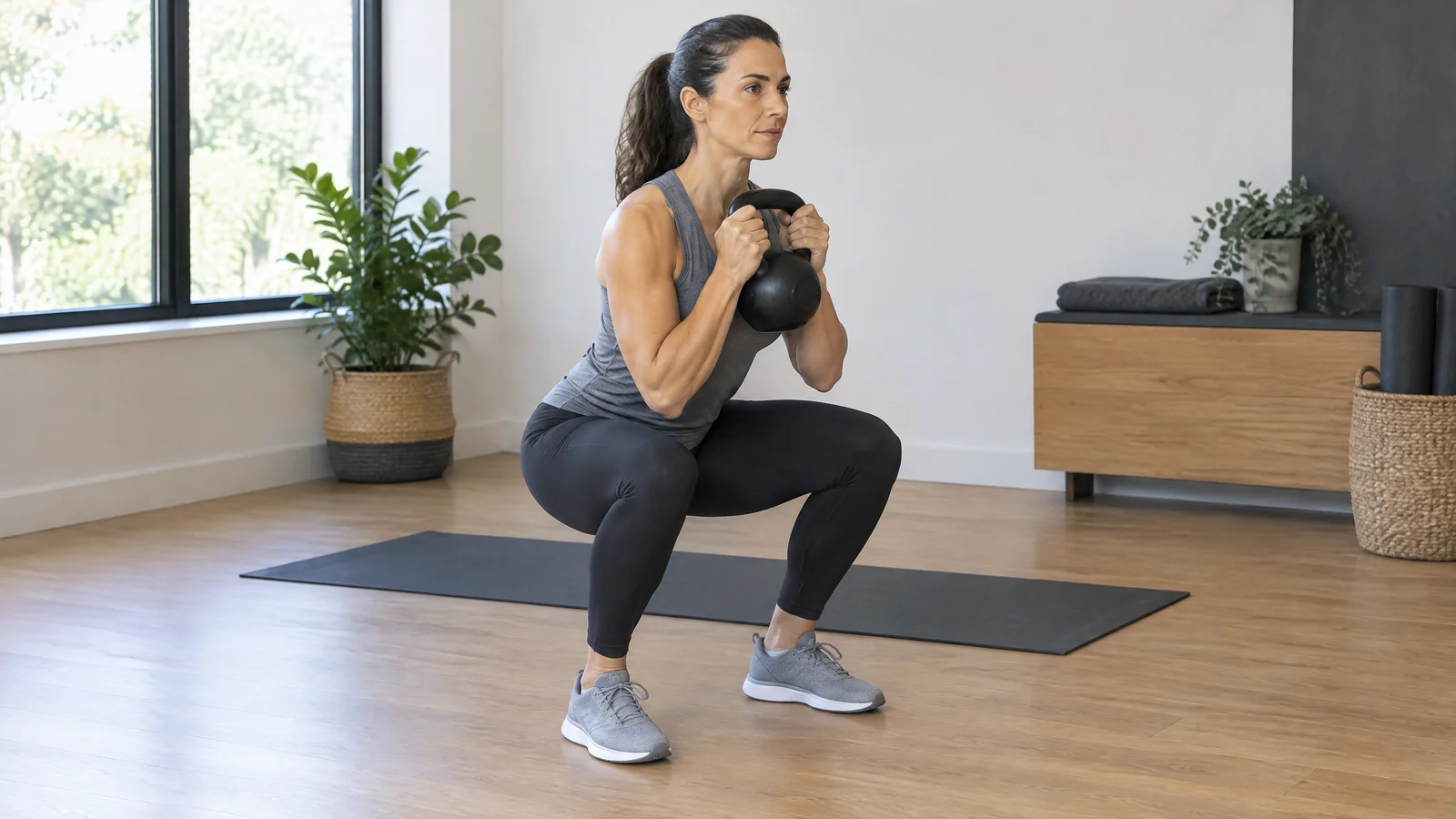
In the squat pictured above, the kettlebell is held in front of the chest. The equipment does not tell you whether the main purpose is learning a movement, increasing the load or organising training volume. That depends on how the exercise is used. Kettlebell training over 40: four exercises for your routine explains the technique and suitable starting points.
Choose a useful focus
Start with a specific task rather than a catch-all goal such as getting fitter. Would you like to control more weight in a familiar exercise? Make muscle growth your priority? Or practise quick, controlled force production with qualified guidance? Your answer determines what is worth recording in your training notes.
The exercise selection can stay manageable when you begin. Calisthenics and kettlebells: strength without a gym provides accessible exercises and two training sessions. Make a new movement reliable before increasing the demands of load or speed. Stop the exercise if it causes pain. If your technique is uncertain, learn new explosive movements with a qualified professional.
Planning also includes what you eat on training days. Daily protein intake and strength training over 40 covers food choices, reference values and example meals. To keep track of those meals, you can record them in the The 8 Protocol food diary. The core app is free.
Common questions
Do I have to choose between strength and muscle growth?
You can emphasise one without excluding the other. The ACSM review found changes in several qualities across different forms of resistance training. Specific goals influence how training is organised, but they do not turn it into entirely separate methods. 1
Is a heavy repetition automatically power training?
The load alone does not decide this. Mechanical power also depends on how quickly the work is done. ACSM defines power training as deliberately performing the lifting phase as quickly as possible. Overcoming a heavy resistance and performing a movement quickly are different emphases. 12
Do I need a special repetition range after 40?
The ACSM review used here does not establish a separate range beginning on your 40th birthday. It covers healthy adults of different ages, mostly with limited training experience. An appropriate programme depends on your goals, experience and individual circumstances. 1
For the energy metabolism behind short efforts, Glycine and creatine: how they connect explains creatine synthesis and its connection to ATP.
If you visit a sauna after training, heat deserves a separate look. Sauna: How Your Body Responds to Heat explains circulation, sweat and breaks.
What to take into your next session
Muscle size, the load you can lift and mechanical power answer different questions. The distinction becomes useful when you define a specific goal and observe progress in a way that matches it. In the context of longevity, it also shifts attention beyond muscular appearance towards movement and physical tasks.
The underlying research describes training outcomes in groups of healthy adults. It does not provide a personal medical exercise programme or show that a particular combination extends life. Health conditions or physical limitations call for individual professional guidance on exercise selection.
Sources
- Currier BS et al. ACSM Position Stand: Resistance Training Prescription for Muscle Function, Hypertrophy, and Physical Performance in Healthy Adults. Medicine & Science in Sports & Exercise, 2026. DOI: 10.1249/MSS.0000000000003897. Overview of 137 systematic reviews. Source for training outcomes, load, volume, power training and scope. Accessed 10 November 2026.
- Urone PP, Hinrichs R. Physics, section 9.1: Work, Power, and the Work–Energy Theorem. OpenStax, 2020. Physical definitions of work and power. Accessed 10 November 2026.