
Rep ranges for muscle growth: what fits your training?
The eighth push-up might already feel demanding, while someone else could comfortably keep going after twelve. The number alone tells you little about how hard a set is. Eight to twelve reps is a useful option for building muscle, not an exclusive window. Other ranges can fit too, provided resistance, effort and training volume work together.12

Why 8 to 12 is not the only option
In a gym, you can adjust the weight in small increments. At home, you may have only your body weight or a pair of rings. A broader rep range gives you more flexibility: a suitable exercise does not become unsuitable just because a set lasts longer than twelve reps.
The traditional split between low reps for strength, moderate reps for size and high reps for endurance is too rigid. These adaptations overlap. Load still matters, but it does not determine muscle growth on its own.1
Muscle growth and maximal strength are different goals
If you want to lift as much weight as possible for one repetition of a particular exercise, practising with heavy loads is part of that specific task. Research reviews generally favour heavier loads over light ones for improvements in tested maximal strength. Similar changes in muscle size do not necessarily mean the same strength gains.24
Local muscular endurance asks another question: how long can a muscle repeat a particular task? That differs from muscle size. Strength, muscle size and power: what are you training? explains those distinctions. Here, the focus is choosing reps when muscle growth is your main goal.
How broad is the range for muscle growth?
The commonly discussed range of roughly 5 to 30 reps is a practical guide, not a biological boundary. Studies have compared different loads and training programmes rather than testing every individual rep count. Researchers have also examined muscle changes outside that range. Five is not a switch that turns growth on, and thirty is not a precise upper limit.1
One clear example comes from a twelve-week trial in resistance-trained young men. One group used 8 to 12 reps and the other 20 to 25, with both taking sets to voluntary failure. Changes in the measured muscle fibre cross-sectional areas did not differ statistically between groups. Sets longer than twelve reps can therefore have a place in muscle-building training.3
A network meta-analysis also found no statistically significant difference in hypertrophy between its loading categories when sets were taken to voluntary failure. That condition matters: these were highly demanding sets, not any amount of easy movement with a light weight.2
The more useful question: how many reps were left?
Load is the resistance you move. Effort, in this context, describes how close that set takes you to the limit of the reps you could perform. A light weight can feel very demanding by the end of a long set.
A practical way to describe this is repetitions in reserve, or RIR. Two RIR means you estimate that you could complete about two more reps with comparable technique. Extra attempts using momentum, a shorter movement or assistance are a different task.4
The ACSM’s 2026 position stand describes roughly two to three reps in reserve as one possible guide to sufficient effort. This gives you a way to gauge effort. Estimating reserve takes practice, especially when you are new to training.4
That leaves room to train hard without turning every set into a failed attempt. In a small eight-week trial involving experienced lifters, stopping with an estimated one or two reps left produced similar changes in the thigh muscles studied to training to failure. Failure sets also caused greater acute performance losses during training.5
Why light sets can still be hard
Your nervous system controls muscle fibres through motor units. Each unit consists of a motor neuron and the muscle fibres it supplies. Higher force demands also require units with higher recruitment thresholds. As fatigue develops during a longer set with a light load, additional units can be recruited. Whether recruitment fully matches that of heavier loading remains uncertain.1
This helps explain why a light weight and an easy set are different things. In a small study of untrained men, stopping light-load sets well before failure was less favourable for measured muscle development than taking them to failure. The study did not test the small difference between zero and one or two RIR.6
The popular idea of the “last five effective reps” can draw attention to the end of a set. Treating it as an exact counting rule goes too far. Research on loading and set endpoints does not establish a universal law in which precisely five reps count and everything before them contributes nothing.14
Heavy, moderate or light: the practical trade-offs
The ranges below are planning examples, not separate growth zones. Their boundaries overlap. Choose according to your goal, a familiar movement, the equipment available and a set length you can work with.14
Rep counts for muscle growth also tell you little about how to train endurance, balance or rapid force production. If your interest is maintaining a broad range of physical abilities as you age, keep those other tasks in view rather than treating one rep range as a complete fitness programme.
Technique belongs in the decision
If your movement gets shorter with each rep or you increasingly compensate, the numbers become less comparable. Choose a load and variation that let you control a familiar movement. A strong sensation in a particular muscle, by itself, proves neither good technique nor future growth.
In a ring row, resistance and the task depend on the setup and body position rather than a number printed on a weight. Your body weight provides the resistance. Gymnastic rings training: choose your exercises covers suitable attachment points, variations and technique.

Burning during a long set is neither proof of growth nor a reliable reserve counter. Pain, dizziness or unusual breathlessness are reasons to stop the effort rather than force out more reps. Persistent or recurring symptoms need professional assessment. Seek qualified instruction for a new movement or one you cannot yet control under load.
Consistency and progress you can follow
A training space you can use and a repeatable routine are often more practical than searching for a perfect plan. The current ACSM position stand also emphasises regular resistance training and an approach that fits personal goals and circumstances.4
For a familiar exercise, note the variation, resistance, reps in each set and estimated reserve. This makes it easier to see whether you can do more with comparable technique, rather than simply collecting larger numbers.
An example of progression
For an exercise you already know, choose a range of 8 to 12 reps with roughly two reps in reserve. Keep your existing number of work sets unchanged at first.
If you repeatedly reach the upper end across your work sets with comparable technique and the intended reserve, you can increase resistance by a small, manageable step in a later session. You may then complete fewer reps again. The range is a planning tool, not a special growth zone.
If your technique becomes unreliable before the lower end, choose less resistance or a more suitable variation you have learned. This is a general planning example, not an individually prescribed programme.
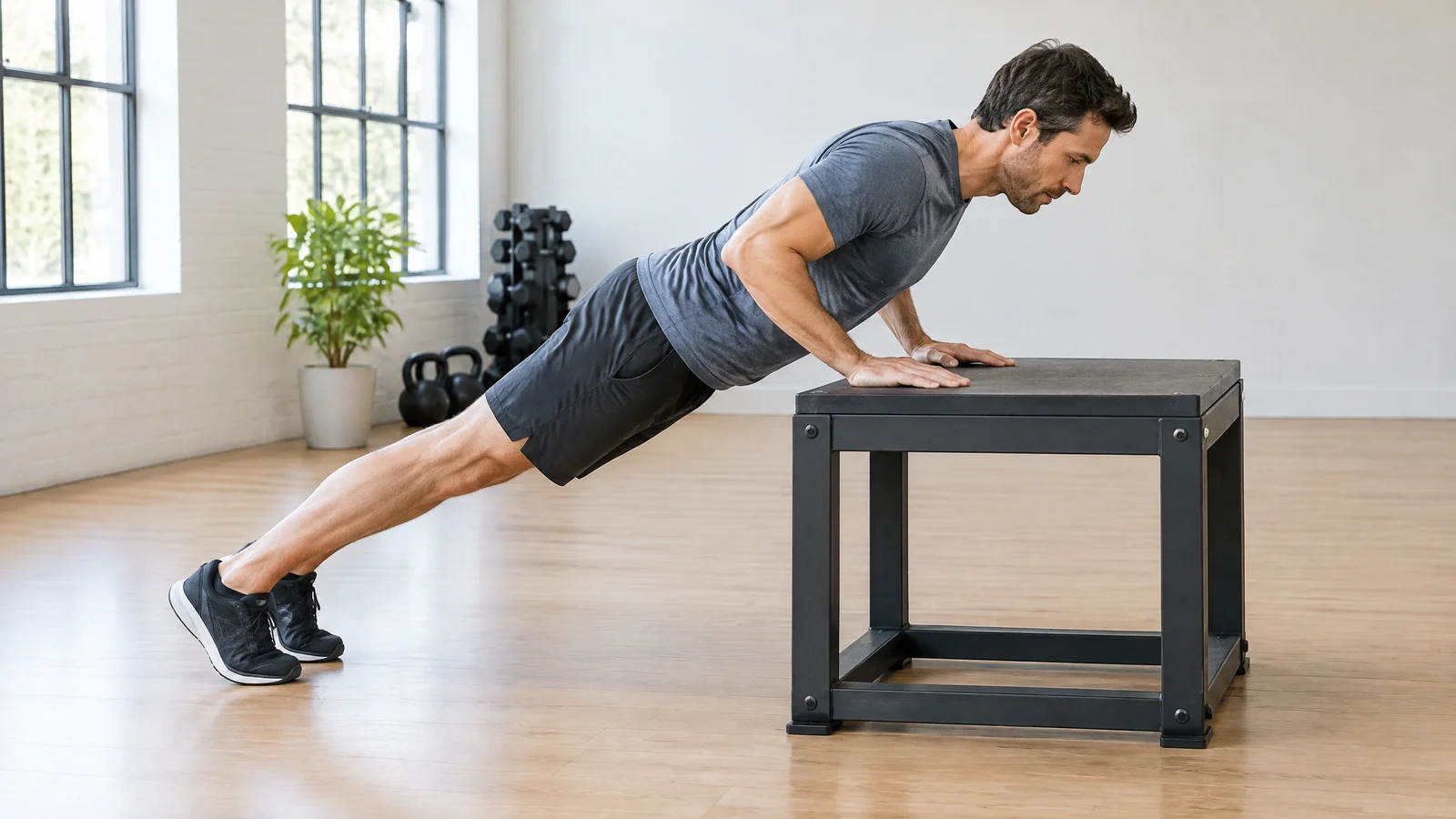
For push-ups, raising your hands creates a different variation from the floor version. Use only a stable, non-slip support suitable for that load. The calisthenics exercise guide shows accessible variations. A more demanding version makes sense once you have learned it, not simply because your current rep count has become high.
Recovery and food are part of the routine
Make room for sleep, regular meals and food intake that fits your demands. Those are planning tasks of their own, alongside choosing a rep range.
Planning extends beyond the final rep. Allow recovery between demanding sessions and consider whether you can train reasonably well again next time. A suitable number of sets and sessions also depends on the rest of your training volume. Continually adding more is no substitute for a manageable plan.4
For nutrition, look at your food and protein intake rather than deriving a supplement requirement from a rep count. Protein for strength training over 40: amounts and meals explains the reference amounts and practical meals. To keep track of actual portions and protein, you can log your meals in The 8 Protocol food diary.
What to take into your next session
Eight to twelve reps can stay in your plan. You can also widen the range to suit the exercise, equipment and goal. More informative than the count alone is the combination of resistance, controlled technique, effort and a training volume you can repeat consistently.
The research describes groups of healthy adults, often young men. It cannot predict your individual muscle growth or identify a special rep range that starts at forty. Medical conditions or relevant limitations call for individually informed professional guidance.
Common questions
Can I use 8 to 12 reps for every exercise?
It can serve as a shared planning range. The load, learned technique and intended effort still need to fit each exercise. There is no requirement to use the same count for everything.14
Are sets of 20 reps only for muscular endurance?
No. Higher reps can also form part of muscle-building training. In loading-comparison studies, the sets were highly demanding and often taken to failure.23
Do I need to take every set to failure?
No. Leaving a small estimated reserve is one way to manage demanding sets. That does not establish one optimal RIR value for everyone or require risking a failed attempt in every exercise.45
Sources
- Schoenfeld BJ et al. Loading Recommendations for Muscle Strength, Hypertrophy, and Local Endurance: A Re-Examination of the Repetition Continuum. Sports, 2021. DOI: 10.3390/sports9020032. Narrative review covering loading ranges, recruitment and practical trade-offs. Accessed 11 November 2026.
- Lopez P et al. Resistance Training Load Effects on Muscle Hypertrophy and Strength Gain. MSSE, 2021. DOI: 10.1249/MSS.0000000000002585. Network meta-analysis of sets performed to voluntary failure. The 2022 corrigendum did not change the main findings. Accessed 11 November 2026.
- Morton RW et al. Neither load nor systemic hormones determine resistance training-mediated hypertrophy or strength gains in resistance-trained young men. Journal of Applied Physiology, 2016. DOI: 10.1152/japplphysiol.00154.2016. Twelve-week loading comparison in resistance-trained young men, with sets to voluntary failure. Accessed 11 November 2026.
- Currier BS et al. ACSM Position Stand: Resistance Training Prescription for Muscle Function, Hypertrophy, and Physical Performance in Healthy Adults. MSSE, 2026. DOI: 10.1249/MSS.0000000000003897. Overview of reviews, literature search through October 2024. Load, effort, reserve and programming in healthy adults. Accessed 11 November 2026.
- Refalo MC et al. Similar muscle hypertrophy following eight weeks of resistance training to momentary muscular failure or with repetitions-in-reserve in resistance-trained individuals. Journal of Sports Sciences, 2024. DOI: 10.1080/02640414.2024.2321021. Abstract: eight weeks, 18 trained participants, leg press and knee extension with one or two RIR versus failure. Accessed 11 November 2026.
- Lasevicius T et al. Muscle Failure Promotes Greater Muscle Hypertrophy in Low-Load but Not in High-Load Resistance Training. JSCR, 2022. DOI: 10.1519/JSC.0000000000003454. Abstract: eight weeks in untrained men, light and heavy loads with different set endpoints. Accessed 11 November 2026.