Kettlebell training over 40: four exercises for your routine
One kettlebell, a clear workout space and two scheduled sessions: that is enough equipment to get started. Kettlebells combine controlled strength work with dynamic movements. Here you will find the swing, goblet squat, clean and press, and snatch, with pictures, technique steps and a weekly plan that grows with your skills. You do not need to master all four on day one.
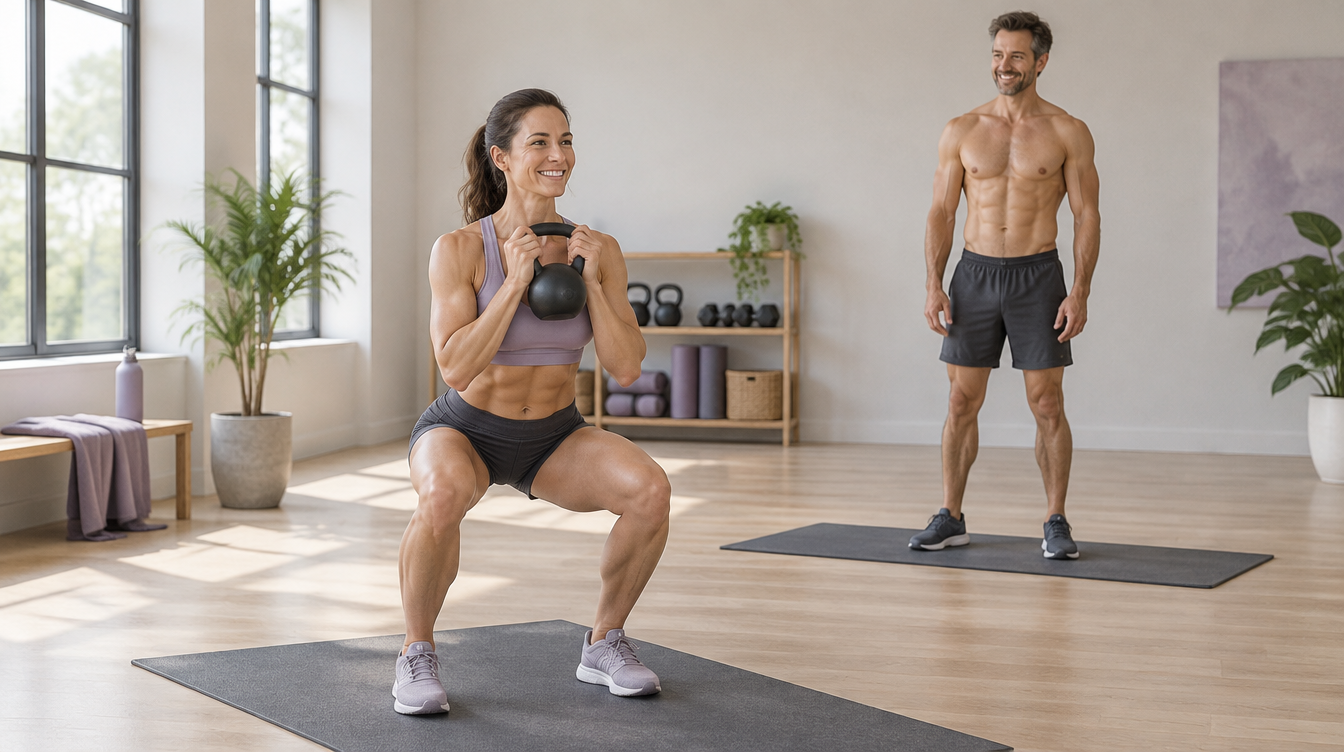
What the training offers
Train for strength with little equipment. Squats challenge your legs and glutes; overhead presses work the shoulders and arms. Swings teach you to extend your hips powerfully while keeping your torso stable. One supervised kettlebell study reported improvements in measures including grip strength and lifting performance. Your progress depends on your starting point, exercise selection and training.1
Variety without a roomful of machines. A goblet squat is a controlled squat; a swing is a dynamic hip movement. The clean and press combines bringing the weight to your shoulder with pressing overhead. Later, the snatch adds a more technically demanding movement to an overhead position. A small set of exercises can give you different movement skills to practise.
A routine that fits your day. Schedule Tuesday and Friday, for example. Record the weight and repetitions. Your next goal does not have to be a heavier kettlebell: a smoother clean or a better-controlled swing is progress too.
Which kettlebell weight is right for you?
Weight guide for women
- New to strength training: Try 8 kg for deadlifts, goblet squats and, later, learning the swing. If you cannot control it securely, a lighter option, such as 4 or 6 kg, is a better learning step.
- Regular strength training, but new to kettlebells: 8 to 12 kg is a useful range to try. Start at the lower end for an unfamiliar movement. Experience with other weights does not replace kettlebell technique.
- Established kettlebell skills: 12 to 16 kg, or more where your skills support it, can suit two-handed basics. This is not an automatic next step or a required weight for presses or snatches.
Weight guide for men
- New to strength training: Try 12 kg for the basics. If picking it up or performing the movement under control is not yet possible, 8 kg can be a better learning load.
- Regular strength training, but new to kettlebells: 12 to 16 kg, often 16 kg for well-controlled two-handed basics, is a useful starting guide. 20 kg is not a universal beginner weight.
- Established kettlebell skills: 16 to 24 kg may suit two-handed basics; 20 kg is a possible intermediate step. More demanding one-arm or overhead movements may still need substantially less.
These are coaching guidelines to try, not fixed ability categories. Technique, strength-training experience and the exercise matter more than being in the women’s or men’s category. An experienced 16 kg swing and a newly learned 6 kg press can both suit the same person. You do not need to stay in one weight category for every exercise.7, 8, 10
Why you do not need the same bell for all four exercises
- Goblet squat: Both hands hold the bell close to your chest. Choose a load that lets you perform several calm squats without pushing the bell away or losing your position.
- Two-handed swing: Your hips and legs generate the drive. With practice, this can often use more weight than a press. Learn the hip hinge through deadlifts first. Being able to lift a bell does not mean you can swing it safely yet.
- Clean and press: Choose for the limiting movement, usually the press, and your less capable side. If you can clean the bell but can only press it using knee drive or arching your back, it is too heavy for the strict press described here.
- Snatch: Not a beginner strength test. Learn the swing and clean first, then hand insertion with technique feedback. Choose the load again for this movement rather than automatically using your swing weight.
Try this weight check before buying
Where possible, try two neighbouring weights in a gym, class or coached session. A number on an internet list cannot replace this short practical check.
- Pick it up securely: Perform five two-handed deadlifts, setting the bell down calmly each time. Keep your back in its natural position; do not yank the bell off the floor.
- Check your intended exercise: Use only a movement you already know, such as five controlled goblet squats. Choose a light, manageable press load separately. Swings and snatches are not spontaneous shopping tests if you have not learned them yet.
- Leave a reserve: For slow strength exercises, finish feeling that approximately two more good repetitions would be possible. If you compensate, hold your breath frantically or simply struggle to get the bell up, choose less. For swings, consistent movement quality matters more than pushing to exhaustion.
- Consider both sides: Choose one-arm loads for the side on which you are less confident. You do not need different weights on each side.
If you want to buy just one bell: Choose for your first training routine, not a future snatch goal. A manageable load for deadlifts and goblet squats is more useful than buying a heavy bell in advance. If you also want to press one-handed, a second, lighter bell may be more useful than compromising on one weight for everything. An adjustable kettlebell is another option; it must suit your planned movements and lock securely.
Why a swinging bell feels different
A kettlebell’s mass does not change when it swings. Accelerating, redirecting and decelerating it does create additional dynamic forces. Its body also sits outside your grip. This can make a moving load feel much more demanding than simply holding it. There is no universal rule that turns “12 kg into 30 kg”.
The recommendation is not “always use the lightest bell”, but use a load that lets you learn and control the specific movement. Even with a light bell, do not turn the swing into an arm lift. Technique feedback is more useful than extra kilograms.
Clear your training area and keep furniture, people and pets out of the way. Overhead exercises also need sufficient ceiling clearance. Stop if you feel pain. If you have an injury, symptoms or uncertainty about your capacity, seek individual professional guidance before starting.
1. Kettlebell swing: the hips provide the drive
The two-handed swing to approximately chest height described here starts with a hip hinge. It is neither a deep squat nor a lift powered by the arms. Practise the deadlift first: bell between your feet, hips back, both hands on the handle, stand with control and lower it again.4
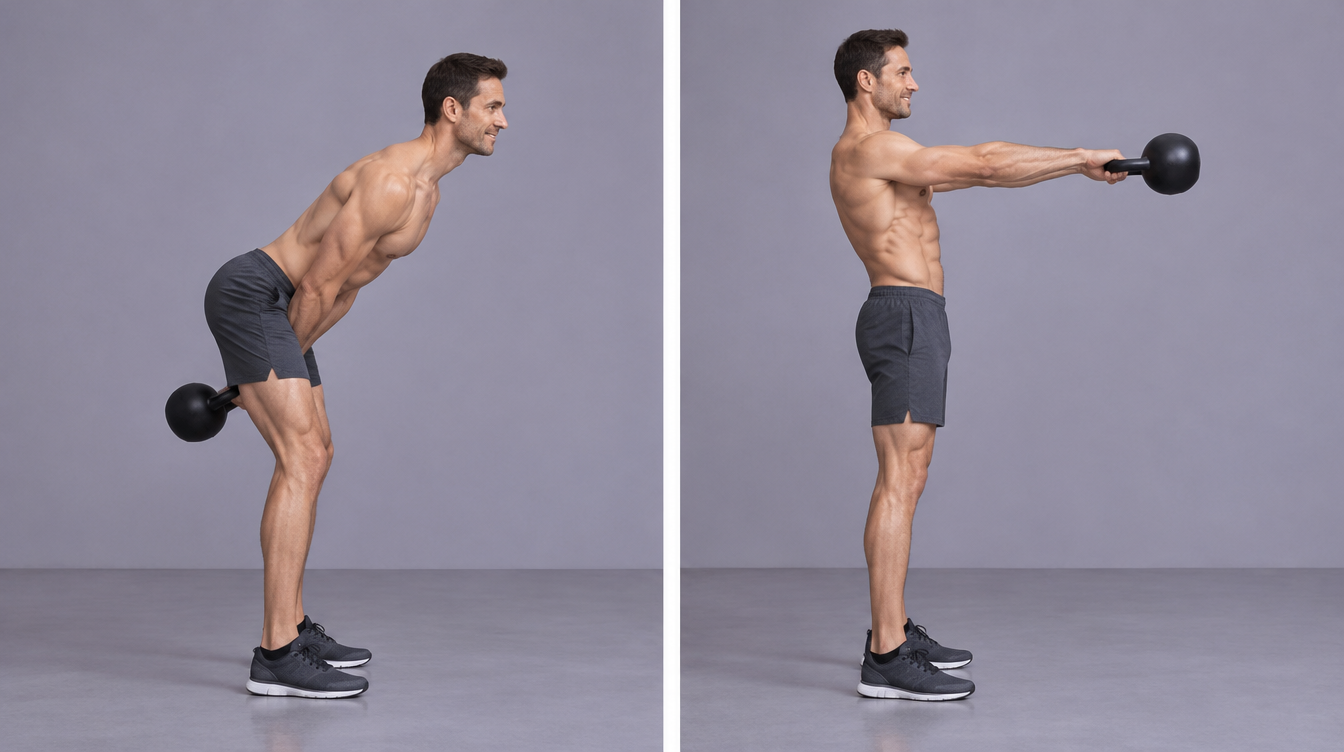
How the movement works:
- Put the kettlebell a short distance in front of your feet. Stand roughly shoulder-width apart, push your hips back and slightly bend your knees. Grip with both hands, keep your back in its natural shape and brace your torso.
- Tilt the bell towards you and hike it high between your thighs. Keep your arms long as your hips move back.
- Extend your hips powerfully until you stand upright. This impulse lets the bell float forwards to approximately chest height. Do not lift it with your shoulders or lean backwards at the top.
- Let the bell swing back. As your arms return towards your body, move your hips back. To finish, guide the bell from the final backswing to the floor in front of you with control.
Common mistakes: squatting too deeply, rounding your back, pulling with bent arms or throwing the bell progressively higher. Your focus: hips drive the bell; arms guide it. Learn the backswing and finish in short sets with technique feedback first.
2. Goblet squat: keep the weight close
In a goblet squat, you hold the kettlebell at your chest. This keeps the movement straightforward and gives you a clear reference point for your posture.3
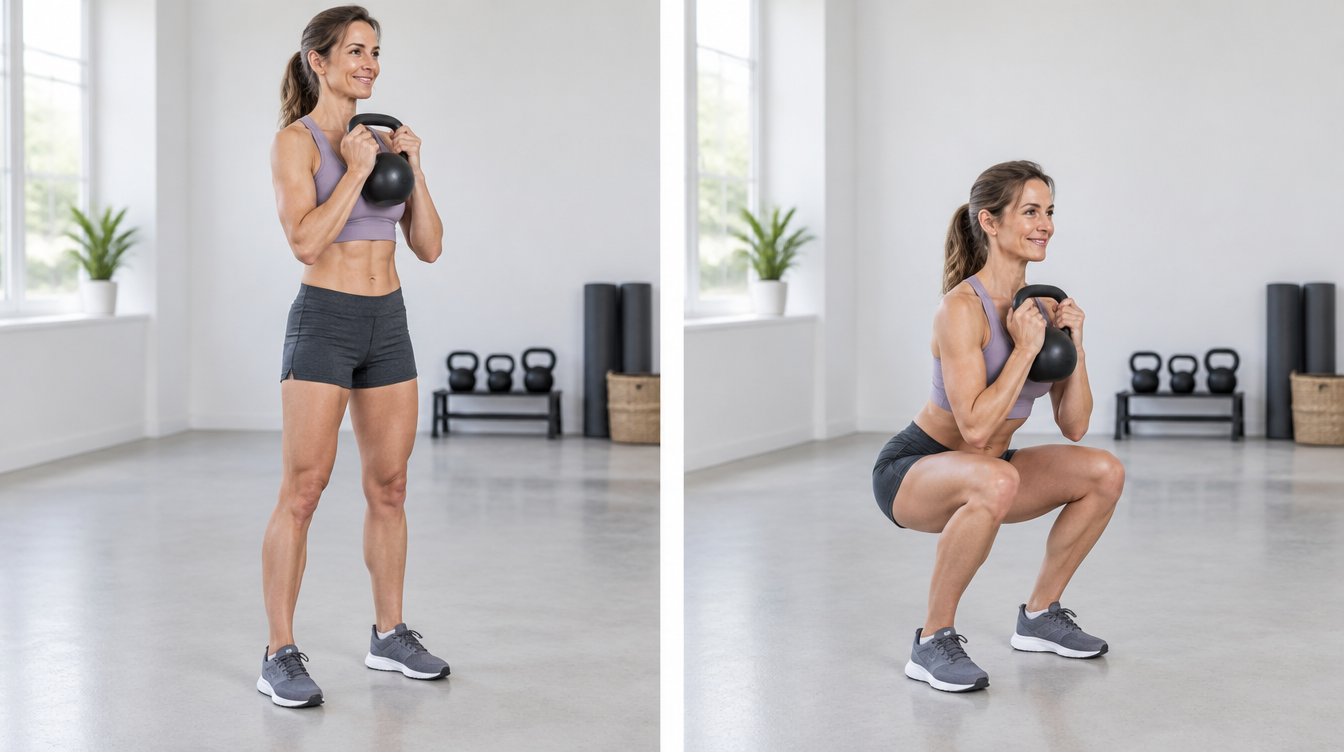
- Pick up the bell with control and hold the sides of its handle in both hands, close to your chest. Your elbows point down.
- Place your feet roughly shoulder-width apart, toes slightly out if appropriate. Spread pressure across the whole foot.
- Bend your hips and knees. Your knees follow your toes, your chest stays upright and your back keeps its natural shape.
- Lower only as far as you can control while keeping your heels down. Stand without bouncing or using momentum.
Common mistakes: holding the weight far from your body, lifting your heels or forcing extra depth with a rounded back. Your focus: a shallower controlled squat is more useful than a deeper repetition that loses its position.
3. Clean and press: shoulder first, then overhead
This exercise has two parts. In the clean, you bring the bell close to your body into the rack position at your shoulder. In the strict press, you press it overhead without driving with your legs. Practise the parts separately first and choose a weight you can also control in the press.4,5
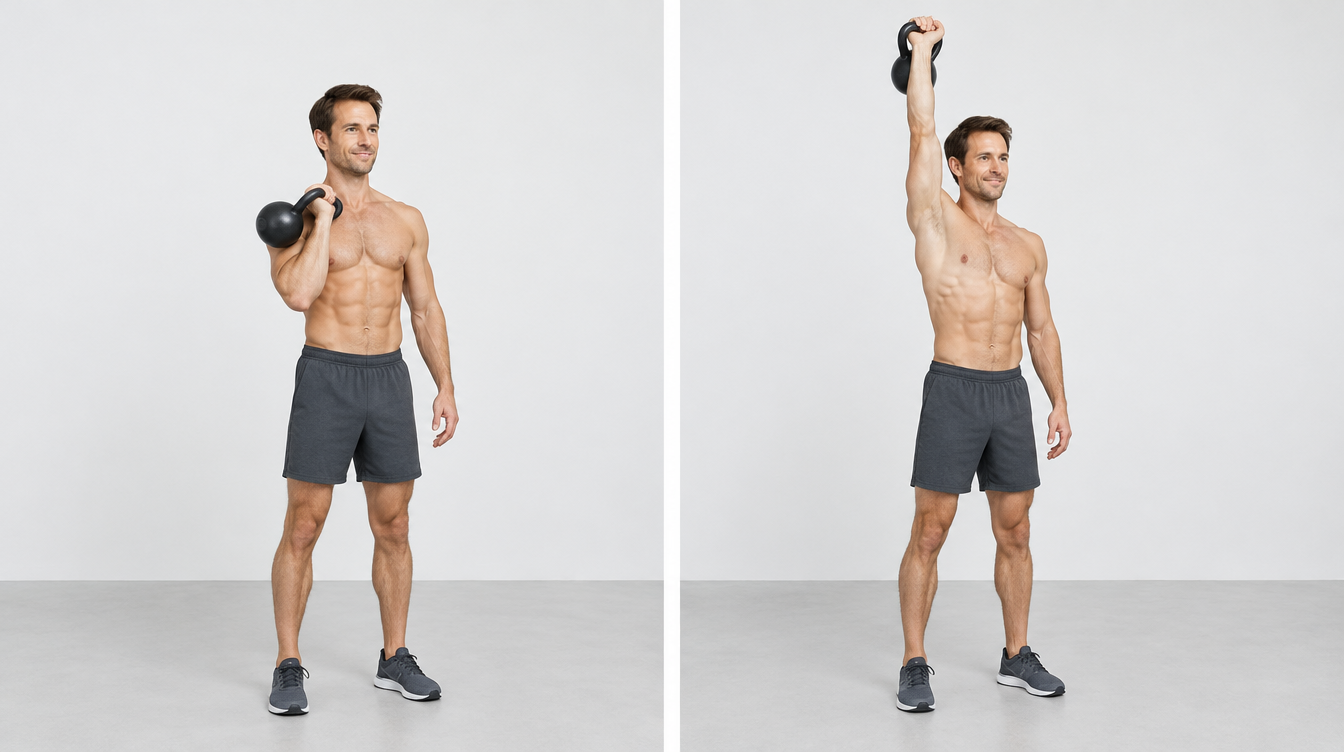
- Start with a hip hinge and a short backswing, as in a one-arm swing. Hip drive sends the bell upwards; keep it closer to your body than in a swing.
- Guide your elbow close to your body and pass your hand through the handle. Let the bell roll around your hand into the rack instead of striking your forearm from above.
- Pause in the rack: elbow close to your torso, wrist approximately straight, bell body outside your forearm. Stand tall and brace your torso.
- Press the bell overhead with control. Finish with your arm extended roughly beside your ear, without arching your back or bending your knees to drive the weight.
- Lower the bell to the rack with control first. Then use the clean return you have learned to lower and park it safely before changing sides.
Common mistakes: turning the clean into a biceps curl, banging the bell onto your forearm, bending your wrist back or leaning backwards in the press. Your focus: a smooth clean and steady press matter more than linking them quickly with too much weight. Learn the rack and return with personal technique feedback.
4. Kettlebell snatch: a later technical step
A snatch takes the bell overhead with hip drive in one continuous movement, without stopping in the rack or adding a press. It requires a dependable single-arm swing, a controlled overhead position and practised handling. It is not essential when you first start training.6
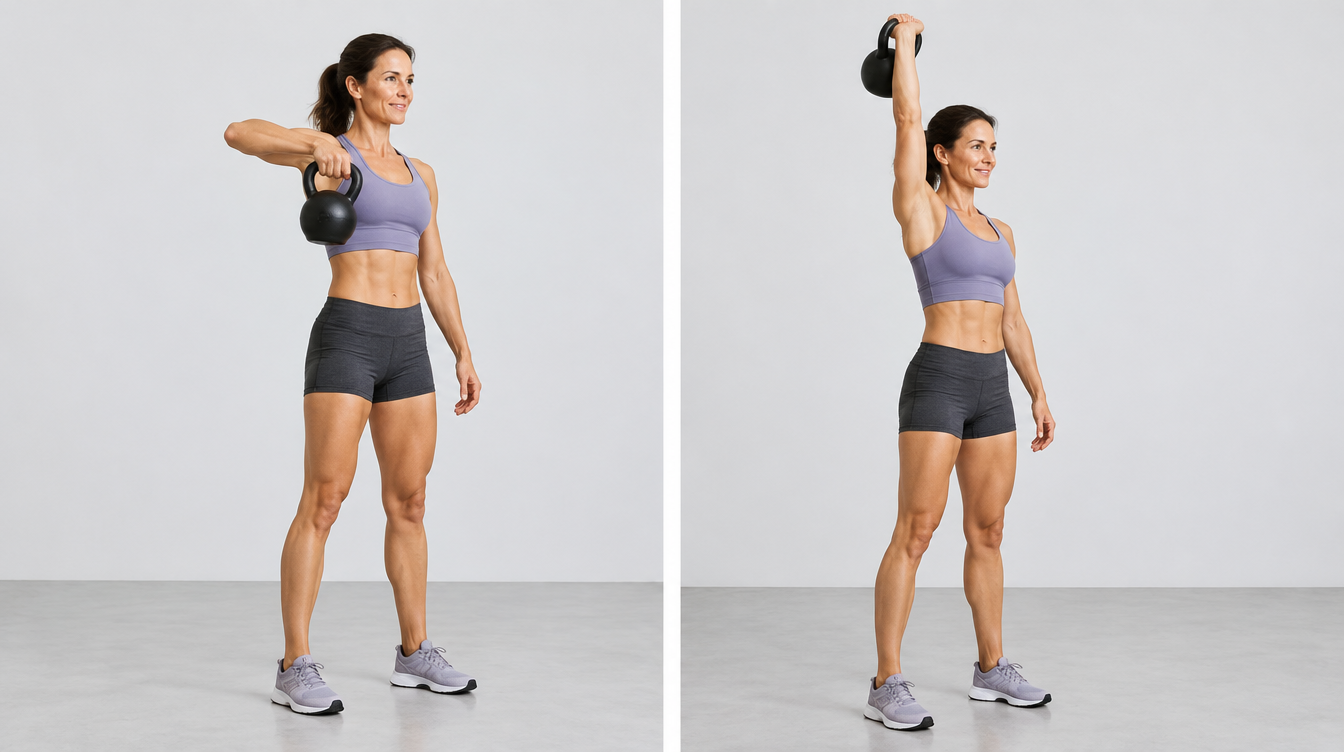
Understand the movement before practising it:
- Start from a single-arm backswing. Extend your hips to send the bell upwards while keeping your back in its natural shape.
- Guide the bell upwards close to your body, briefly bending your elbow. A large arc far in front of you makes the transition harder.
- As the bell briefly floats, pass your hand through the handle and extend your arm. The bell settles behind your forearm rather than flipping onto it.
- Finish upright with the arm extended overhead. Keep your wrist approximately straight and your torso stable, without leaning backwards.
- Learn the return as deliberately as the upward movement. Practise it under instruction first instead of letting the bell drop uncontrollably or adding long strings of repetitions on your own.
Common mistakes: inserting the hand too late, letting the bell strike the forearm or pressing out the final part. Your focus: a few clean technique attempts with a light weight. If your swing, hand changes or overhead position are not yet dependable, stay with the earlier learning steps.
Your weekly plan: build a base, then add skills
Schedule Tuesday and Friday, for example, with days off between them. Warm up with a few minutes of brisk movement, practise unloaded hinges and squats, and start with an easy practice set. Two regular sessions are straightforward to organise; general resistance-training guidance supports a recurring training schedule.2
Stage 1 · Foundations
Your first session in approximately 20 minutes
This suits you if: You are starting out or still building a dependable hip hinge, grip and controlled finish. Today's goal is repeatable movement, not maximum exhaustion.
- Minutes 0 to 4: Move briskly, practise unloaded hip hinges and do a few bodyweight squats. Aim to warm up, not tire yourself out.
- Minutes 4 to 9: Try an appropriate load. Practise picking up and setting down the bell with deadlifts, then a few easy goblet squats. No swings or overhead movements yet if you have not learned them.
- Minutes 9 to 18: Deadlift for 2 sets of 6 to 8 repetitions, then goblet squat for 2 sets of 5 to 8. Rest roughly 1 to 2 minutes between sets. Choose a load for each exercise and leave approximately two good repetitions in reserve.
- Minutes 18 to 20: Put the bell away safely and record your training. Schedule your next session. You have completed a first workout you can build on.
The timing is a framework, not a race. If you need more rest or technique practice, extend the session or do fewer sets. After swing instruction, you can replace some of the deadlift block with 3 short sets of 5 swings. Without instruction, stay with deadlifts.
Your next step: Repeat the same straightforward session. Your last repetition should look as controlled as your first. Consider stage 2 only once your swing, rack and light press are dependable.
Stage 2 · Build a routine
Combine swings, squats and presses
This suits you if: You can park a swing under control, hold a steady rack and perform a light press without leaning back. Work through the exercises in sequence; keeping hold of the bell throughout is not the goal.
- Swing
- 3 sets of 8 repetitions. End the set earlier if hip drive, backswing or grip starts to deteriorate.
- Goblet squat
- 2 sets of 6 to 8 repetitions. Keep the bell close, feet stable on the floor and each repetition controlled.
- Clean and press
- 2 sets of 3 repetitions on each side. Choose for your press and less confident side. Park the bell under control between repetitions or sides if needed.
Your next step: Record weights and repetitions separately for each exercise. Improve one variable first, such as a smoother clean or one more good squat repetition, rather than making everything heavier at once.
Stage 3 · Refine your skills
Learn the snatch as a separate skill
This suits you if: Your one-arm swing, clean and stable overhead position are already dependable. Learn hand insertion and the controlled return with qualified technique feedback.
Following instruction, begin with single repetitions and deliberate resets. Initially replace some other work rather than adding snatches as an exhausting finisher. Choose the load again for this movement.
Your next step: Have your hand insertion and return checked. Until these are dependable, stay with swings, squats and presses. You do not need the snatch to build a good training routine.
Start with roughly 1 to 2 minutes of rest between sets, or longer as needed. These are general examples, not an individual programme. Your controlled execution determines the appropriate stage, not a fixed calendar week. Finish a set as soon as grip or posture starts to deteriorate.
When should you use a heavier kettlebell?
Not after a fixed number of weeks, but when you can repeatedly perform your current task well. Turn “more weight eventually” into a clear next step:9
- Build repetitions first: For goblet squats, for example, keep the same bell and progress from 2 sets of 6 to 7 and then 8 repetitions. Do not increase load, sets and speed together.
- Review the load: As a simple training rule, after two consecutive sessions with 2 good sets of 8, ask: Did the bell stay steady? Did my posture stay consistent? Could I still have done approximately two good repetitions? If not, keep the same weight.
- Try the next step briefly: Once the current load has become too easy, try an available heavier bell for a few controlled repetitions and rebuild from the lower end of your range. If you compensate or cannot meet your planned minimum with good form, stay with the existing bell or try a smaller intermediate step. Reassess each exercise: a heavier swing bell does not automatically become your new press bell.2, 9
Kettlebell jumps can be bigger than they look: Moving from 8 to 12 kg adds 50 percent to the load; from 16 to 20 kg adds 25 percent. That can be too much in one step, especially for presses. More controlled repetitions with your current bell can be the more useful progression. The squat repetition rule does not apply to swings: hip drive, backswing, grip and parking the bell must remain dependable through the last repetition. Snatches initially remain technique practice, not a chase for a heavier bell.
A training note might read: “Goblet squat, 8 kg, 2 × 6, steady, approximately two more reps possible. Next session: same weight.” This is an example, not a weight prescription. Record both sides for one-arm exercises. Even this simple record shows whether you are progressing. Missing a session does not mean doubling the next one.
Where does food fit in?
If you also want to keep track of meals alongside training, a food diary can simplify the organisation. Record food in The 8 Protocol and keep workout notes in your calendar or notebook, for example. Our guide to nutrition values and portions helps you get started with food logging.
The basic version is permanently free; Plus is optional. View The 8 Protocol on the App Store.
Sources
- Meigh et al. (2022), BELL trial. Supervised training in previously insufficiently active adults aged 59 to 79, without a separate randomised control group.
- ACSM (2009), Progression Models in Resistance Training for Healthy Adults. General training principles, not a test of the example plan assembled here.
- ACE Exercise Library: Goblet Squat. Exercise technique.
- StrongFirst: The Kur for Your Kettlebell Swing and Clean. Technique, controllable loads and preparatory exercises.
- ACE: Advanced Kettlebell Workout for Increased Strength and Conditioning. Clean, rack and press, partly described with two bells.
- ACE / SHAPE: How to Do the Kettlebell Snatch. Movement sequence and advanced prerequisites.
- Greg Brookes: What Weight Kettlebell Should You Start With? Coaching guidance: often 8 kg for women and 12 or 16 kg for men; later weights depend on skills and exercise.
- Living.Fit: How to Pick the Right Kettlebell Weight, with guidance from Marcus Martinez. Distinguishes one-arm and two-handed exercises. Coach/vendor guidance, not a universal weight prescription.
- Greg Brookes: Progressive Overload With Kettlebells. Build repetitions within a planned range, then increase load with consistent technique; no fixed weekly schedule.
- StrongFirst Kettlebell: What kettlebell sizes do I need? Weight selection based on strength; coach/vendor guidance, not fixed progression stages.